Dynamic Load Management for EV Charging Sites
Coordinate EV charger demand around shared site capacity for apartments, workplaces, hotels, businesses, and small CPO networks where the installation supports it.

From site capacity to charger-level limits.
Dynamic Load Management works best when electrical capacity, charger grouping, OCPP control behavior, and day-to-day ownership are configured as one operating workflow.
Confirm available site capacity
Start from the electrical design, protection limits, metering approach, and capacity that can safely be used for EV charging.
Group chargers into charge pools
Organize chargers that share the same capacity envelope so administrators can manage the building, parking area, or charger group as a whole.
Apply compatible OCPP limits
Use charging profiles or related control workflows for compatible chargers, then validate how each charger applies limits and reports status.
Monitor active sessions and adjust
Review charger demand, active connectors, sessions, priorities, and reports so the operating setup can be tuned as usage grows.
Capacity controls with charger pools and profiles.
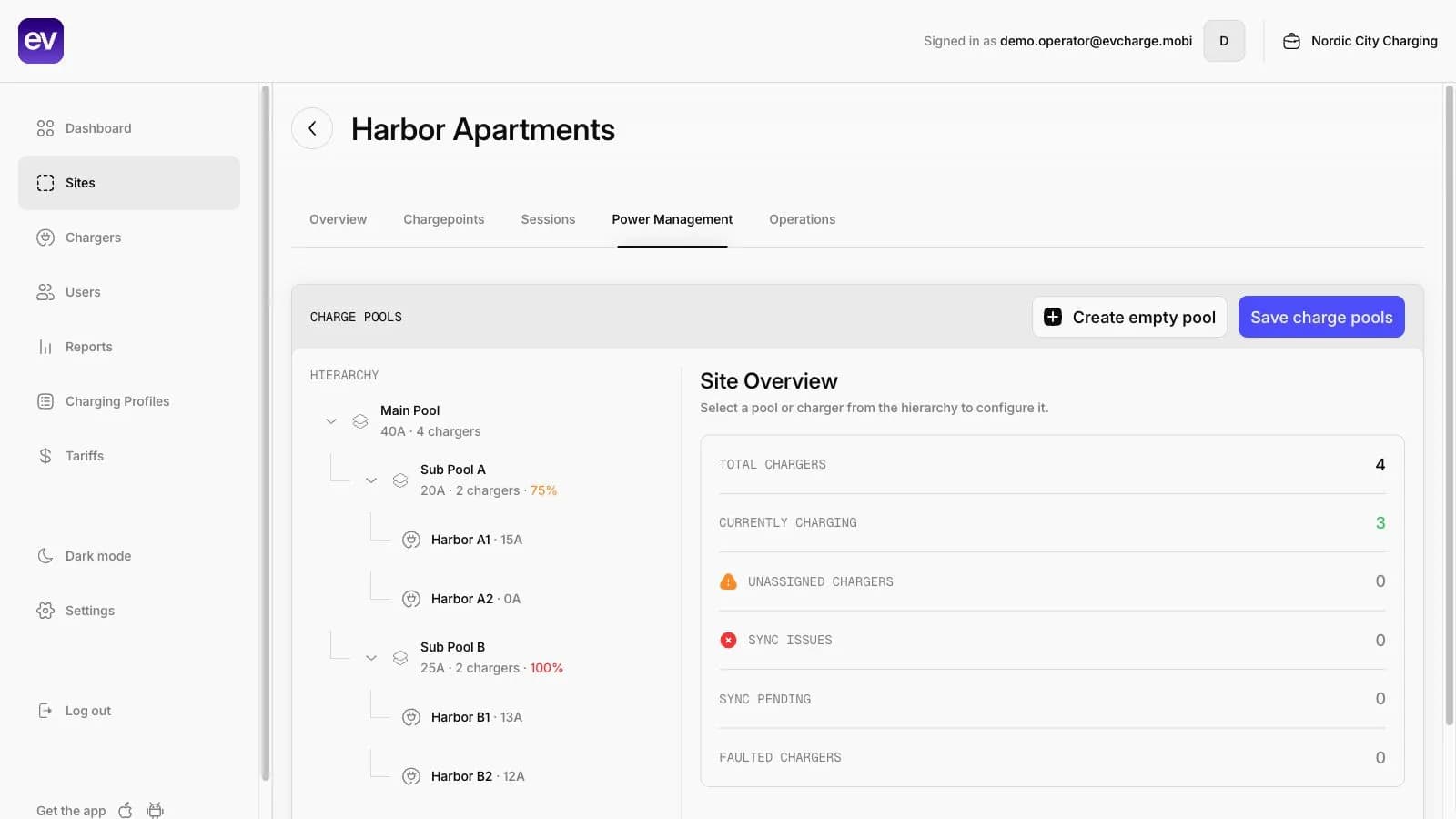
The CPO Portal can show how shared site capacity is represented through charger pools, charger-level limits, and charging profiles for compatible chargers.
Charging profiles list
See Smart Charging, recurring workplace, and DLM ChargePointMaxProfile examples in one profile view.
Connected charger detail
Inspect charger identity, site, connector status, and operational details after connection.
Dynamic Load Management availability and behavior depend on charger support, OCPP profile handling, site configuration, and operational setup.
What Dynamic Load Management depends on.
Dynamic Load Management is an operating control layer, not a replacement for electrical design, protection, metering, or installer review.
- Required
Electrical design
Confirm the installation capacity, protection, wiring, cabinet limits, and local requirements with qualified professionals.
- Required
Compatible chargers
Validate that chargers support the required OCPP control behavior and apply charging limits correctly.
- Required
Metering or capacity input
Confirm how site capacity is measured, configured, or calculated for the operating setup.
- Recommended
Operational ownership
Decide who manages site limits, charger pools, priorities, exceptions, and follow-up after handover.
Bring your chargers online today.
Create a free CPO Portal account and connect your first OCPP charger in minutes.